
If you’ve heard people talk about Bitcoin, Ethereum, or “crypto” and still aren’t sure what any of it actually means, you’re not alone. This guide breaks down cryptocurrency for beginners in plain language — no jargon left unexplained, no assumptions about what you already know.
By the end, you’ll understand how cryptocurrency works, the different types of digital assets out there, how wallets and exchanges function, and what to think about before you ever consider buying any. You can also explore live data on our own tracked cryptocurrencies page as you read. This is educational content, not financial advice — cryptocurrency carries real risk, and nothing here should be treated as a recommendation to invest.
What Is Cryptocurrency?
Cryptocurrency is a form of digital money that exists only electronically — there are no physical coins or bills. Instead of being issued by a government or controlled by a single bank, most cryptocurrencies run on a decentralized network of computers that verify and record transactions.
The name comes from cryptography, the mathematical techniques used to secure transactions and control the creation of new units. Bitcoin, launched in 2009, was the first cryptocurrency to work this way. Since then, thousands of other digital assets have been created, each with different purposes and designs. You can browse how thousands of these coins compare on data platforms like CoinMarketCap or CoinGecko.
At its core, cryptocurrency is an attempt to let people send value to one another directly, without needing a bank or payment processor to approve the transaction in the middle.
How Does Cryptocurrency Work?
Cryptocurrency systems rely on three main components working together: a blockchain to record transactions, a network to verify them, and cryptographic keys to prove ownership.
Blockchain
A blockchain is a shared digital ledger — essentially a continuously growing list of transaction records, called blocks, that are linked together in order. Once a block is added, it’s extremely difficult to alter, because doing so would require changing every subsequent block across a majority of the network’s computers at once.
Rather than one company storing this ledger on a private server, copies exist across thousands of independent computers (called nodes) around the world. Different blockchain networks are also compared and ranked by size and activity on our chain ranking page.
Crypto Transactions
When someone sends cryptocurrency, that transaction is broadcast to the network, checked by other participants for validity, and then bundled into a new block. Depending on the network, this confirmation can take anywhere from seconds to several minutes.
Most networks charge a small transaction fee, often called a “gas fee” on networks like Ethereum, which compensates the computers doing the work of processing and securing transactions.
Public and Private Keys
Ownership in cryptocurrency isn’t tied to a name or an account number the way a bank account is. Instead, it’s tied to a pair of cryptographic keys:
- A public key (or wallet address) works like an account number — you can share it so others can send you funds.
- A private key works like a password — it proves you own the funds at that address and lets you authorize transactions.
Anyone who has your private key can control your funds, which is why protecting it is one of the most important parts of using cryptocurrency safely.
How Is Cryptocurrency Different From Traditional Money?
Traditional money (fiat currency) is issued and backed by a government, and transactions typically pass through banks or payment networks that verify and record them centrally.
| Feature | Traditional Money | Cryptocurrency |
|---|---|---|
| Issued by | Central banks/governments | No central issuer (for most cryptocurrencies) |
| Record-keeping | Private bank databases | Public, distributed blockchain |
| Transaction verification | Banks and payment processors | Network of independent computers |
| Physical form | Cash and coins available | Exists only digitally |
| Ownership proof | Bank account/ID | Private keys |
Neither system is inherently “better” in every way — they’re built for different purposes, with different trade-offs around control, privacy, speed, and regulation.
What Are the Main Types of Cryptocurrency?
Bitcoin
Bitcoin (BTC) is the original cryptocurrency and generally still the largest by market value. It’s designed primarily as a decentralized alternative to money, with a total supply that’s permanently capped. You can track how much of the total market Bitcoin currently controls on our Bitcoin dominance page.
Ethereum
Ethereum (ETH) is both a cryptocurrency and a broader platform. Beyond simply transferring value, Ethereum allows developers to build “smart contracts” — self-executing code that runs on the blockchain — which power applications ranging from decentralized finance tools to digital collectibles.
Altcoins
“Altcoin” is short for “alternative coin” and refers to any cryptocurrency other than Bitcoin. Interest in altcoins tends to rise and fall in cycles, which you can follow on our altcoin season index.
Stablecoins
Stablecoins are cryptocurrencies designed to hold a steady value, typically by being pegged to a traditional currency like the US dollar. It’s worth noting that stablecoins are not risk-free — their stability depends on how they’re backed and managed.
DeFi Tokens
DeFi (decentralized finance) tokens are associated with platforms that recreate financial services — lending, borrowing, trading — without traditional banks or brokers acting as intermediaries, typically using smart contracts to automate transactions.
What Is a Crypto Wallet?
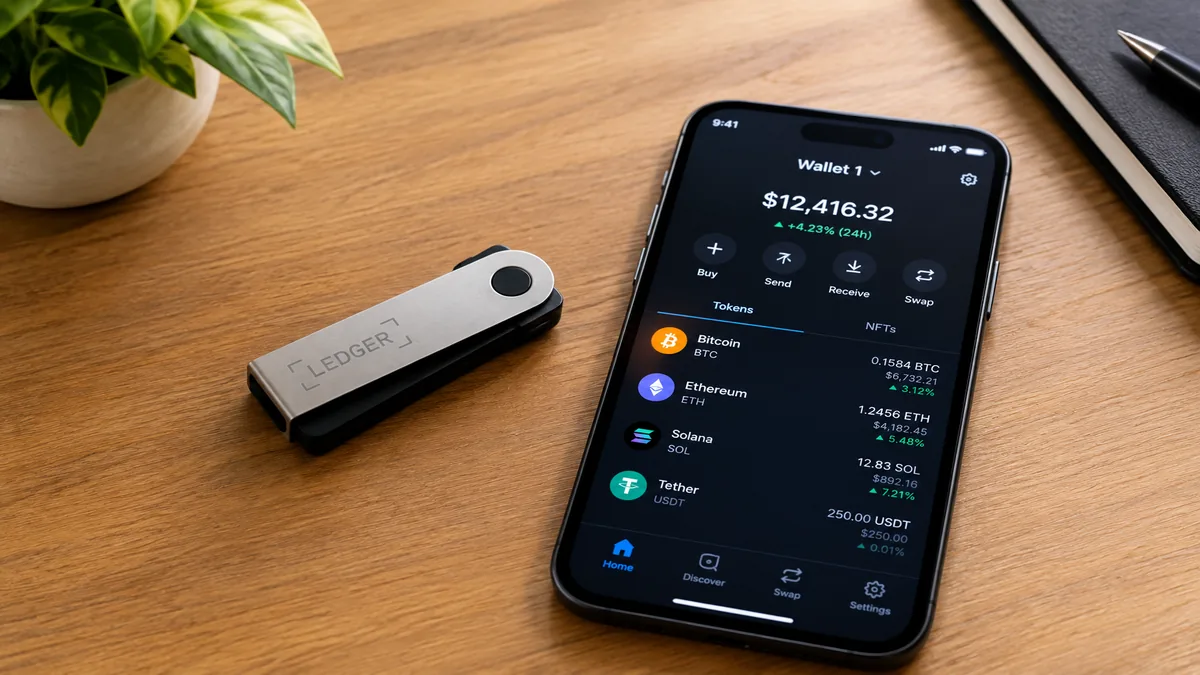
A crypto wallet doesn’t actually “store” your cryptocurrency the way a physical wallet stores cash. Instead, it stores the private keys that give you access to your funds on the blockchain.
Hot Wallets
Hot wallets are connected to the internet — think mobile apps or browser extensions. They’re convenient for frequent use but generally considered more vulnerable to hacking since they’re online.
Cold Wallets
Cold wallets store your private keys offline, often on a dedicated hardware device. They’re less convenient for everyday transactions but are widely regarded as more secure for holding larger amounts long-term.
Public Keys
Your public key (or address) is what you share to receive funds — similar to sharing an email address.
Private Keys
Your private key authorizes transactions from your wallet. It should never be shared with anyone.
Seed Phrases
A seed phrase (recovery phrase) is a sequence of typically 12 to 24 words generated when you create a wallet. It can restore access to your wallet if your device is lost, damaged, or stolen. Anyone who obtains your seed phrase can also access your funds, so it should be written down and stored securely offline.
What Is a Cryptocurrency Exchange?
A cryptocurrency exchange is a platform where people can buy, sell, or trade cryptocurrencies, often exchanging traditional currency for digital assets. Exchanges generally fall into two types:
- Centralized exchanges (CEXs), such as Binance, are run by a company that manages the platform, typically holds custody of funds unless withdrawn, and requires identity verification.
- Decentralized exchanges (DEXs) allow peer-to-peer trading directly from personal wallets, without a central company holding custody of user funds.
Each model has different trade-offs around convenience, control, and regulatory oversight, and requirements vary by country. No exchange should be treated as universally “the best” for every user.
How Does the Cryptocurrency Market Work?
The cryptocurrency market operates continuously, unlike traditional stock markets that have set trading hours. Prices are driven by supply and demand across many exchanges worldwide, and can be highly volatile. Many traders track price charts and technical indicators on platforms like TradingView, while overall market mood is often measured through tools like our Fear & Greed Index.
Market Cap
Market capitalization is calculated by multiplying a cryptocurrency’s current price by its circulating supply. Live market cap rankings for thousands of coins are available on aggregators like CoinMarketCap.
Trading Volume
Trading volume refers to how much of a cryptocurrency has been bought and sold over a given period, often 24 hours. Higher volume generally indicates more liquidity and active trading interest.
Price
Crypto prices are determined by what buyers and sellers are willing to trade at, and can shift rapidly based on news, adoption, regulation, and broader market sentiment.
Supply
Supply refers to how many units of a cryptocurrency exist or will ever exist. Some cryptocurrencies have a fixed maximum supply; others have no hard cap.
Circulating Supply
Circulating supply is the number of coins or tokens currently available and actively trading in the market, as opposed to the total supply that may eventually be released.
Market Demand
Demand reflects how much interest there is in buying and holding a particular asset, influenced by factors like utility, adoption, media coverage, and speculation.
How Do Beginners Buy Cryptocurrency?
- Choose a reputable exchange — research its security history, fees, and regulatory standing in your country.
- Create and secure an account — use a strong, unique password and enable two-factor authentication.
- Complete required verification — many regulated exchanges require identity verification (KYC).
- Fund the account — typically via bank transfer, card, or another supported payment method.
- Select the cryptocurrency you want to buy and review current pricing.
- Review the transaction details carefully, including fees, before confirming.
- Store the asset appropriately — either on the exchange, or transferred to a personal wallet.
No exchange should be treated as universally “the best” — the right choice depends on your location, needs, and the platform’s regulatory compliance where you live.
What Should Beginners Know Before Buying Crypto?
- Volatility: Prices can rise or fall sharply within short periods.
- Scams: Fake exchanges, fraudulent investment schemes, and impersonation scams are common in the crypto space.
- Phishing: Fraudulent emails, messages, or websites may attempt to trick users into revealing private keys or login credentials.
- Private keys and seed phrases: Losing these, or having them stolen, can mean permanently losing access to funds.
- Exchange risk: Funds held on an exchange are subject to that platform’s security and solvency.
- Transaction fees: Fees vary by network and platform.
- Regulatory differences: Rules around cryptocurrency vary significantly by country and continue to evolve.
- Tax considerations: Buying, selling, or trading cryptocurrency may have tax implications — consult a local tax professional.
- Research matters: Understanding what a project actually does is an important step before considering any purchase.
Cryptocurrency values can go down as well as up, and there is no guarantee that any digital asset will increase in value over time.
Common Cryptocurrency Terms Beginners Should Know
| Term | Simple Explanation |
|---|---|
| Blockchain | A shared, tamper-resistant digital ledger of transactions |
| Wallet | A tool that stores the keys needed to access your crypto |
| Exchange | A platform for buying, selling, or trading cryptocurrency |
| Token | A digital asset built on top of an existing blockchain |
| Coin | A cryptocurrency with its own independent blockchain |
| Altcoin | Any cryptocurrency other than Bitcoin |
| Stablecoin | A cryptocurrency designed to hold a steady value |
| Market cap | Price multiplied by circulating supply |
| Liquidity | How easily an asset can be bought or sold without affecting its price |
| Gas fees | Fees paid to process transactions on certain networks |
| DeFi | Financial services built on blockchain without traditional intermediaries |
| Private key | A secret code that authorizes access to your funds |
| Seed phrase | A recovery phrase used to restore access to a wallet |
Bitcoin vs Ethereum vs Stablecoins
| Bitcoin | Ethereum | Stablecoins | |
|---|---|---|---|
| Purpose | Decentralized digital money | Programmable blockchain platform | Stable-value digital currency |
| How it works | Verified via a decentralized network with a fixed supply cap | Runs smart contracts that power apps and other tokens | Pegged to an asset, typically a fiat currency |
| Typical use | Store of value, peer-to-peer transfers | Powering decentralized apps, DeFi, and other tokens | Trading, transfers without price volatility |
| Key characteristic | Fixed maximum supply | Smart contract functionality | Price stability (though not guaranteed) |
Common Mistakes Crypto Beginners Should Avoid
- Investing money they can’t afford to lose.
- Skipping research and buying based on hype or social media trends alone.
- Storing seed phrases digitally instead of offline.
- Clicking links from unsolicited messages claiming to be from an exchange or wallet provider.
- Using weak passwords or skipping two-factor authentication.
- Sending funds to the wrong wallet address without double-checking.
- Ignoring transaction fees when making small or frequent transfers.
- Assuming all cryptocurrencies work the same way or carry the same level of risk.
Cryptocurrency for Beginners: A Simple Learning Roadmap
- Learn the basics of blockchain and how transactions are verified.
- Understand the difference between coins, tokens, and altcoins.
- Learn how wallets work, and the difference between hot and cold storage.
- Study how exchanges operate and what verification they require.
- Read about the specific risks before considering any purchase.
- Explore live market data, like our own tracked cryptocurrencies list, to see how prices and rankings move day to day.
- Keep learning — the space evolves quickly, and staying informed is part of using it responsibly.
Frequently Asked Questions
What is cryptocurrency for beginners, in simple terms?
It’s digital money that runs on decentralized computer networks called blockchains, rather than being controlled by a single bank or government.
How does cryptocurrency work?
Transactions are verified by a network of computers and recorded on a blockchain, using cryptographic keys to prove ownership and authorize transfers.
Is cryptocurrency safe for beginners?
It carries real risks, including price volatility, scams, and the responsibility of securing your own private keys. It can be used responsibly with proper research and caution, but it isn’t risk-free.
What is the difference between Bitcoin and cryptocurrency?
Bitcoin is one specific cryptocurrency — the first one created. “Cryptocurrency” is the broader category that includes Bitcoin, Ethereum, stablecoins, and thousands of other digital assets.
Do I need a crypto wallet?
If you want to hold cryptocurrency outside of an exchange, yes — a wallet stores the keys that give you access to your funds.
How do beginners buy cryptocurrency?
Typically through a reputable exchange, after creating and verifying an account, then funding it and purchasing the desired asset.
What is blockchain in simple terms?
A shared digital record of transactions, maintained across many computers instead of one central server, making it difficult to alter after the fact.
What should beginners learn before buying crypto?
The basics of wallets, private keys, exchange risk, volatility, and common scams — understanding these reduces the chance of costly mistakes.