You keep seeing Bitcoin in the headlines. One day a BTC price swing makes the news, the next day someone is arguing about mining or the halving, and it feels like everyone else already knows the basics.
This guide is Bitcoin explained from the ground up. By the end you will know what it is, how a payment travels through the network, why only 21 million BTC can ever exist, where your coins actually live, and what can go wrong. It explains how things work. It is not investment advice, and nothing here predicts where the price will go.
If you are brand new to the whole space, our beginner’s guide to cryptocurrency is a good companion read.
What Is Bitcoin?
Bitcoin is a digital currency that people can send to each other directly over the internet, with no bank or payment company in the middle. A worldwide network of computers keeps the records, and every one of them follows the same rules.
The ticker symbol is BTC. Many people hold it as a digital asset, a bit like keeping gold instead of cash, while others use it for transfers across borders. That is the practical meaning of Bitcoin for most beginners: money-like software that no single company runs.
The biggest difference from a card payment is who holds the master record. With a card, a company does, and it can approve, delay or reverse your payment. Here, the record is shared across the network, so nobody is in charge of it. Keep in mind that availability, taxes and regulation differ from country to country, so check the rules where you live.
How Does Bitcoin Work?
Everything runs on a public ledger called the blockchain. Every payment moves through the same seven steps:
- A transaction is created. Your wallet says, “send this amount to that address.”
- It is broadcast. The payment goes out to the peer-to-peer network.
- Nodes verify it. Computers called nodes check the signature and make sure the coins were not already spent.
- It joins a block. Miners gather valid payments into a candidate block.
- Proof of Work secures it. Miners compete to solve a computational puzzle, and the winner earns the right to add the next block.
- The block is added. It links to the previous block, forming a chain.
- The ledger stays shared. Every full node keeps a copy, so nobody can quietly change history.
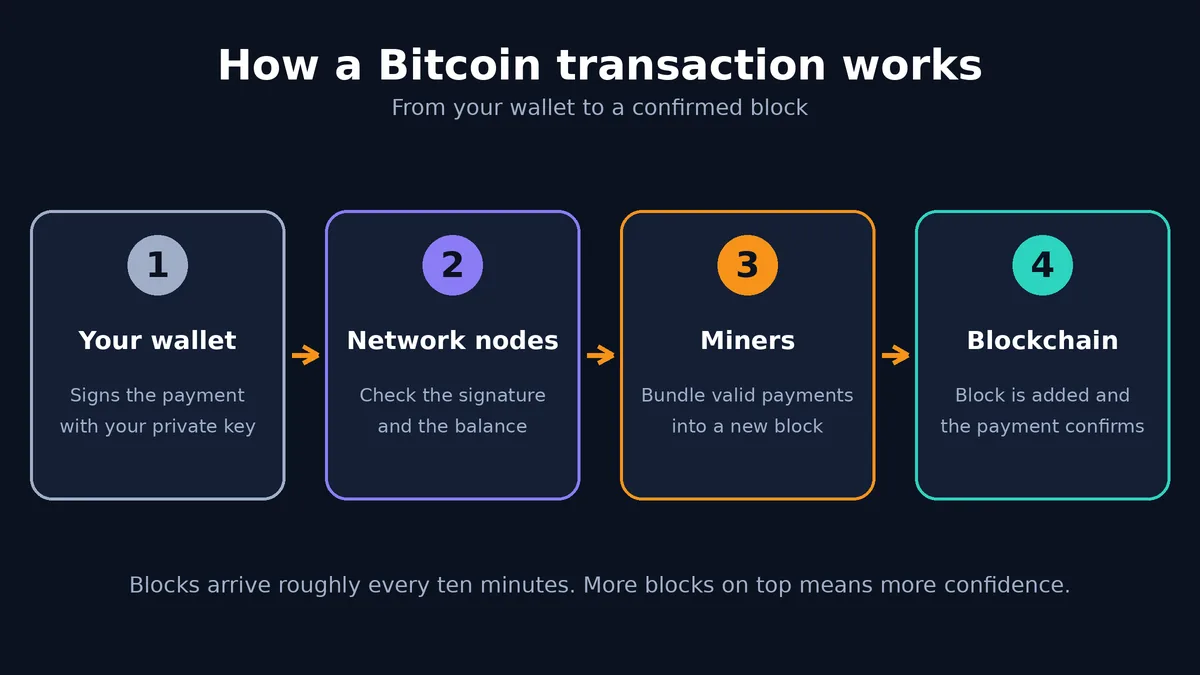
A quick example: Maya wants to pay Sam 0.01 BTC. Her wallet signs the payment with her private key, nodes check it, and a miner includes it in a block. A few blocks later, Sam can treat the payment as settled. Maya and Sam are made-up names, used only for illustration.
Who Created Bitcoin?
It was created by someone, or some group, using the name Satoshi Nakamoto. The whitepaper, titled “Bitcoin: A Peer-to-Peer Electronic Cash System,” appeared in 2008, and the network went live in January 2009. You can read the original document on Bitcoin.org.
What is known: the whitepaper, the early software and the launch timeline. What is not known: who Satoshi Nakamoto really is. That identity is still unconfirmed, so this article does not guess.
How Is Bitcoin Different From Traditional Money?
| Feature | Bitcoin | Traditional fiat money |
|---|---|---|
| Control | Decentralized network | Central banks and governments |
| Issuance | Fixed rules in the protocol | Set by monetary policy |
| Supply | Capped at 21 million BTC | No fixed cap |
| Intermediaries | Not required for transfers | Banks and payment processors |
| Settlement | Confirmed on the blockchain | Varies by payment system |
| Transparency | Public ledger | Private bank records |
This is a factual comparison, not a verdict. Fiat money has legal backing, consumer protections and near-universal acceptance. BTC offers a different design with different trade-offs.
How Many Bitcoins Are There?
The maximum supply is 21 million BTC, and that limit is written into the rules of the network. The circulating supply is the number of coins already mined and available, and it is always lower than the maximum.
New coins enter circulation as mining rewards. Some are also lost for good, for example when an owner loses the private key, so the usable supply may be smaller than the circulating figure suggests.
The circulating number changes with every block. For the current figure, check a live source such as CoinMarketCap instead of trusting a number printed in an article.
What Is Bitcoin Mining?
Mining is the process that adds new blocks and keeps the network secure. Miners use specialized computers to compete in a Proof of Work puzzle. The winner adds the next block and collects a block reward plus the transaction fees inside it.
It matters for three reasons:
- It verifies and orders transactions.
- It makes rewriting history extremely expensive, which protects the network.
- It is how new BTC is issued.
The protocol adjusts the mining difficulty about every two weeks, so new blocks keep arriving roughly every ten minutes no matter how many miners join. Mining also uses a lot of electricity, which is a real environmental debate. Treat strong claims on either side with caution and check them against credible research.
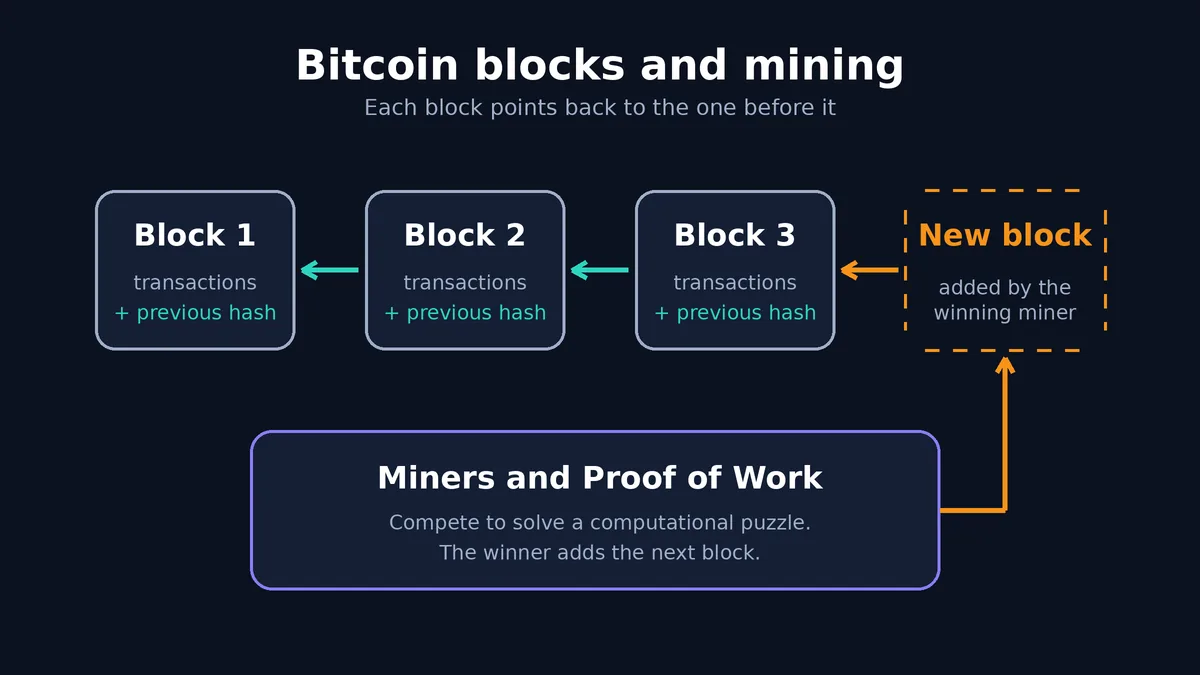
Each block stores a fingerprint, called a hash, of the block before it. Changing an old block would break every link that follows, which is why history is so hard to rewrite.
What Is the Bitcoin Halving?
The halving is a scheduled event that cuts the block reward in half. It happens every 210,000 blocks, which works out to roughly every four years. The reward started at 50 BTC per block in 2009 and has been halved several times since.
Halvings slow down new issuance, and that is how the supply creeps toward 21 million. They do not automatically push the price up. Price depends on many other forces, covered below.
What Is BTC?
BTC is the ticker symbol, just as USD is the code for the US dollar. People often write “Bitcoin” with a capital B for the network and “bitcoin” or “BTC” for the unit, though usage varies.
The unit is divisible. The smallest piece is the satoshi, and 1 BTC equals 100,000,000 satoshis.
What Determines the Bitcoin Price?
The Bitcoin price, often quoted as BTC USD, is set by buyers and sellers on exchanges. Factors that can move it include:
- Supply and demand
- Market liquidity
- Market sentiment and trading activity
- Macroeconomic conditions
- Institutional activity
- Regulation and legal news
- Conditions across the wider crypto market
The BTC price changes every second, so check it on a live market-data platform such as CoinGecko. No article can reliably predict future prices, and past performance does not guarantee future results. If you want to understand what a price chart is actually showing, read our complete guide to reading crypto charts.
What Is Market Cap?
Market cap equals the price multiplied by the circulating supply. It tells you the total market value of every coin in circulation, not what one coin costs. A higher price per coin does not automatically mean a bigger market cap, because supply matters too.
How Do Transactions Work?
Every payment uses a few basic building blocks:
- Wallet: software or hardware that manages your keys.
- Address: a public identifier where BTC can be received.
- Private key: a secret that authorizes spending. Never share it.
- Public information: payments and addresses are visible on the blockchain.
- Transaction fee: paid to miners, and it rises and falls with demand.
- Confirmation: each new block on top of your payment adds confidence. Many services wait for several confirmations before treating a payment as final.
Payments cannot be reversed, so double-check the address every single time before you press send.
Where Is Bitcoin Stored?
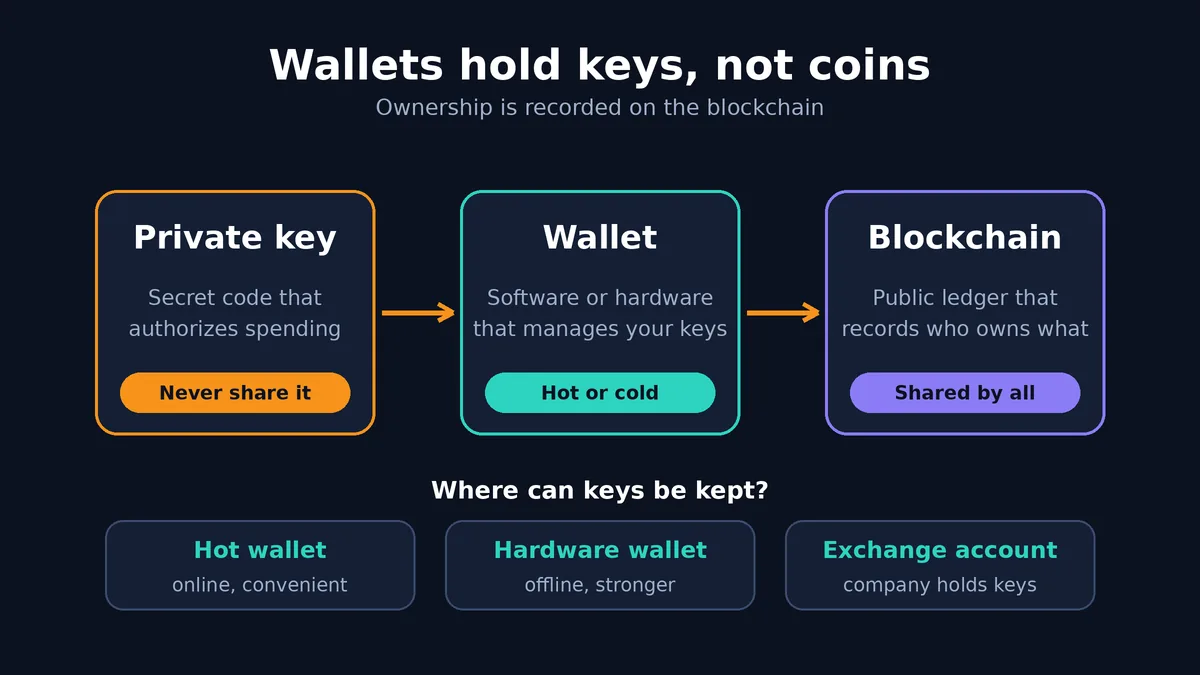
Strictly speaking, the coins are not stored inside a wallet. Ownership is recorded on the blockchain, and the wallet holds the keys that prove you can spend them. Here is how the common options compare:
| Option | Who holds the keys | Online? | Main trade-off |
|---|---|---|---|
| Hot wallet | You | Yes | Convenient, but more exposed to online attacks |
| Cold wallet (hardware) | You | No (offline) | Stronger security, but needs care and a backup |
| Custodial exchange account | The exchange | Yes | Easy to use, but you depend on the company |
Holding your own keys is called self-custody. It gives you full control and full responsibility, because lost keys can mean lost funds.
What Are the Main Benefits?
- Peer-to-peer transfers without a traditional intermediary
- Global access with nothing more than an internet connection
- A decentralized network with no single operator
- A transparent public ledger
- A limited maximum supply
- Divisibility down to the satoshi
- Portability, since access depends on keys instead of physical cash
What Are the Risks and Limitations?
- Volatility: prices can swing sharply in a short time.
- Scams and phishing: fake websites, giveaways and impersonators are common.
- Lost private keys: lose the key and the funds may be gone for good.
- Custodial risk: an exchange can fail, be hacked or freeze withdrawals.
- Regulation: rules, access and taxes differ by country.
- Irreversible payments: a mistake usually cannot be undone.
- Fees and congestion: cost and speed vary with demand.
- Environmental concerns: the energy use of mining is debated.
How Does It Compare With Other Cryptocurrencies?
BTC was the first cryptocurrency and is usually seen as a digital store of value and a payment network. Altcoins are every other cryptocurrency. Ethereum is the best known of them, built mainly as a platform for smart contracts and decentralized finance. They serve different purposes, so they are not simple rivals.
Is Bitcoin the Same as Cryptocurrency?
No. Bitcoin is one cryptocurrency, while “cryptocurrency” is the wider category. Thousands of other digital assets exist, each with its own design and its own risks.
How Can Beginners Learn More?
If you want a simple Bitcoin for beginners study path, work through these steps in order:
- Start with the basics: what it is and how blocks work.
- Learn how wallets work.
- Understand private keys and why they matter.
- Study transaction basics: addresses, fees and confirmations.
- Learn market terms such as market cap, liquidity and volume.
- Build good security habits: strong passwords, two-factor authentication and phishing awareness.
- Research any exchange carefully, including whether it is available in your country.
Good reference points include the Coinbase Learn guide and Binance Academy. Taxes and regulation vary by country, so check with your local authority too.
Bitcoin FAQs
What is Bitcoin in simple terms?
It is a digital currency that works over the internet without a central bank or company controlling it.
How does Bitcoin work?
Users send transactions, nodes verify them, miners group them into blocks, and the blocks are added to a shared public ledger called the blockchain.
What is BTC?
BTC is the ticker symbol, used on exchanges and market-data sites the way a currency code is.
How many Bitcoins will ever exist?
The protocol caps the supply at 21 million BTC. Check a live source to see how many are already in circulation.
What is Bitcoin mining?
Miners use computing power to verify transactions and add blocks through Proof of Work. They earn block rewards and fees for doing it.
What is the Bitcoin halving?
It is a scheduled cut of the block reward in half, roughly every four years or every 210,000 blocks, which slows the issuance of new coins.
Is Bitcoin the same as cryptocurrency?
No. It is one cryptocurrency inside a much larger category of digital assets.
Can you buy less than one Bitcoin?
Yes. One BTC divides into 100,000,000 satoshis, so you can hold a small fraction.
Final Thoughts
Bitcoin is a decentralized digital currency secured by a public blockchain, Proof of Work and a fixed supply cap of 21 million. Once transactions, keys, mining and the halving make sense, the headlines get much easier to follow.
It also carries real risks, from volatility to scams and simple user error. Learn the fundamentals, check live figures on trusted platforms, and make your own informed decisions. For more plain-English guides and free tools, browse CryptoCoinXInfo.